(This photo has nothing to do with anything; I just like it; it's a centaur skeleton created on commission by Skulls Unlimited, a fun online shop I frequent for refreshing my claw collection. My newest acquisitions: sloth and anteater claws, and a whole eagle's foot. All replica, naturally. I do not amputate feet.)
So, I got a question the other day on Not for Robots, and I thought I'd answer it here. It actually coincides with where I'm at on my current w.i.p. so it's good timing. It's from jckandy and it's as follows:
I am writing a novel, but I am not sure what stage I'm at. I have an outline; I have written the begining. I have richly imagined and written a little of the end. But the middle is quite blank! I'm not sure if I should be brainstorming or what. Any advice??? Anyone?
Ah, the dreaded middle! Yes, yes. We all know: starting a book is rillyrilly easy. It takes a high degree of stubbornness to finish a book. So, how do you do it? There are different schools of thought here, different processes that work for different kinds of brains. There are the "flying into the mist" folk, who I think of as fearless, winged explorers, going forth into darkness with just a headlamp. They don't even have a map for god's sake. They crazy.
And amazing. Mist-flyers just start at point A and see where it takes them. As the story unspools beneath their pen nib or fingertips, they figure it out as they go. So there's that way. I can't say much more about it than: how frightening and how beautiful. I am not one of those people.
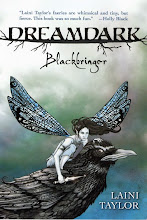
I am a planner. Jckandy, it sounds as if you've already outlined, so maybe you have a natural tendency in this direction. I don't make outlines per se. What I do is tell myself the story over and over until I can kind of get my fingers around it. (My brain fingers.) Until I have enough of a sense of "what's going to happen" and "what it's about" that I feel comfortable moving the narrative forward. I tell myself the story in the most straightforward way, and as I do that, I try to work out the plot, and the "coolest" way it might unfold. To take an example from Blackbringer, I know I want Magpie and Talon to meet, and I want to think of the "coolest" way two young faeries might cross paths. (Really: "coolest" is what I'm shooting for; it's my highly technical term for what I'm after :-) So I brainstorm ways that young faeries might cross paths. What if this? What if that? Suppose this. Imagine that. Until I get an idea that I like and get excited to write the next scene or section. And then I do.
I don't plan out the minutiae of a book beforehand. I just want to feel like I understand well enough where I'm headed. What's "well enough"? Well, it's just intuitive: I want to be excited about my ideas, and yet leave enough mystery that I can play with each section of the story as I come to it, but I need to have confidence that the idea is rich with possibility; I have some notions of things that will happen, but I know new ideas will come up as I go (I count on it) that will make it more than I could have planned at the outset.
So, setting out, I have a grasp of the story, and I'm excited about the ideas that will unfold, and I invariably have certain plot ideas that I think are "cool" that will come into play later. No outline.
And then as I'm writing, I'll brainstorm each chunk or section or installment of the book along the way, figuring out how it will unfold. I may shoot for reaching a certain point -- it's as far as I can see clearly from where I am. (You know the famous quote: "Writing a novel is like driving a car at night. You can see only as far as your headlights, but you can make the whole trip that way." - E.L. Doctorow) So I figure out how to get to that point. It's like swimming to a buoy. Even if you're not a really strong swimmer, you know you can make it from buoy to buoy, so that's what you do. One buoy at a time. Or as Anne Lamott might say: "Bird by bird."
I have a strong sense of the story at the outset, with a lot of mist and mystery. A lot of room for discovery as I go.
Jckandy, you have to think a lot. Think and think and think. What now? What next? That's how you write the middle.
One thing I'm always conscious of is putting questions into the readers' mind. Every step of the way, the reader must be curious about something. That is what keeps them turning the pages. Does it happen to you sometimes, reading, that you're so bursting to find something out you can barely stop yourself from flipping ahead? Happens to me. (Don't tell anyone, but sometimes I peek! I can't help it!)
So what questions have you put into the reader's head that need answers, and when are you going to give those answers? And if you're going to give an answer, you must first plant another question, so they will keep reading. Cultivating the reader's curiosity is key. This is something that I've learned to be conscious of while writing (that I didn't think about consciously while writing my first book). I ask myself: What do I want the reader to wonder? What do I want them to fear? To hope for? Those three things. As writers we must have clarity about those questions, and we must magically transmit them with clarity into our readers' minds.
So, where I'm at in my w.i.p. is that I've reached a buoy and caught my breath. The tricky thing is that each time you reach a buoy, you kind of want to hang onto it for a while, enjoying the sensation of having reached a goal, savoring that accomplishment. You don't want to plunge back into the open sea again, strike out toward that next buoy that's just a bobbing red spot in the distance. You have to gather your courage and strength anew each time. So, this week I've been gathering (and of course, brainstorming. A lot happens before the next buoy, and I'm figuring out the "coolest" way for it to happen.)
I hope this helps, jckandy. As ever, when it comes to writing advice, there are no "secret dance steps" (as Kirby Larson wrote wonderfully in a recent email). There's just stubbornness and courage. Try different approaches until you find the one that fits. Who knows, maybe you're a mist-flyer and you just don't know it yet!
And now, I am off to read -- with great excitement -- a friend's first chapter. Happy writing, all!