Monday, May 04, 2009

First Silksinger review! A giveaway, and the auction for Bridget Zinn

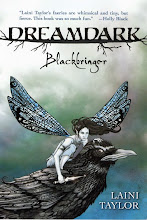
Thank you, thank you, Jen Robinson, for being the first person to review Dreamdark: Silksinger! Reading a first review like THIS ONE is the best possible medicine for my nail-biting anxiety :-) Jen also did a lovely review of Blackbringer last year.

Jen Robinson is a blogger who's passionate about children's literacy, more so than anyone else I can think of. Besides doing book reviews, she uses her blog to promote and educate about literacy, including great round-up posts that collect reading-related material from all over the web. She also blogs for Booklights, the new PBS Parents blog, and creates the Growing Bookworms Newsletter, focused on raising readers. (You can e-subscribe HERE.)

* * *

You can enter to win an advance readers copy of Silksinger in this GoodReads giveaway. I didn't even know this existed at GoodReads -- publishers posting book giveaways. There are quite a few up there. Of course, there are so many requests for each book that the chances of winning are slim, but I still put my name into a hat or two :-) A surer way to get Silksinger is in the auction below. It's not posted yet, but it will be soon:

* * *

Have you heard yet about the auction for Bridget Zinn? If you don't know Bridget, she is a lovely YA writer and youth librarian who has had quite a full year so far. First, she signed with an agent (the awesome Michael Stearns), then she was diagnosed with stage 4 colon cancer, and then she got married. Yeah, you might have noticed that the middle thing is a truly terrible and terrifying thing. Bridget lives in my neighborhood; we first met at the Kidlit Blogger's Conference last fall. I was so excited about her agent news, and when another email came around about more news, I expected it to be more good news -- not cancer. I'm still stunned by it. It seems impossible. Not to mention deeply unfair. An ultra-health-conscious 31-year-old nonsmoking vegetarian, getting cancer? Very little freezes my blood like news of young people with cancer. There ought to be somebody to argue with about his, doesn't it feel like? To make a case and persuade that this ought not happen? Ever? If only.

Bridget has started chemo and has a wonderful care-taker in new-husband Barrett (they were high school sweethearts and have been together for years, but were married by the hospital chaplain right before her surgery), and some local Kidlit folks have started an online auction to help raise some money for Bridget's medical expenses.

There are some great items posted so far, not just signed books but some specialized services like consultations and critiques. (For example, a manuscript critique by Newbery-Honor winning author Cynthia Lord!) Please take a moment to peruse the offerings. Think ahead to Christmas gifts, or start a collection of signed children's and YA titles. It'd be a great time to do so.

Sunday, May 03, 2009

Rathersting Gallery

The Rathersting faerie clan are the guardians of the magical forest of Dreamdark. They live in a huge, ancient yew tree on the face of Dreamdark Crag, from where they can survey the whole vast world of the forest. Besides maintaining peace and stability, they are also responsible for gathering the sticky, clotted web from the dreaded Spiderdowns, which the healer Orchidspike needs for the job of knitting up torn faerie wings. Rathersting are rough faeries without the fine town manners of the Never Nigh folk (who are not suitably appreciative of what the warriors do for them), and they're easy to recognize, because they have tattoos on their faces.

Want to be a Rathersting? You can! (See the end of the post for how to get tattoos of your own.)

Lucy

Alice

Jarrod & Stephanie


Pam


Sophie, almost 7


Sammy, 7, and Josh, 4

Indigo, 8, and Allura, 5


Camille, six


Nayna and Dojo

Nayna and Kiersten


Ben, 8

Mattie, 6

Mattie & Ben


How to get some tattoos?


There are several ways. (No matter which, make the subject header: RATHERSTING TATTOOS.)

1) Post about the Dreamdark books on your blog and email me the link, along with your mailing address.

2) Post a [positive] review of Dreamdark: Blackbringer (or, when the time comes, Silksinger) on Amazon. Email me the link and your mailing address.

3) Email me me a photo of yourself holding a Dreamdark book in your home or town or in some fun, exotic, or unusual place. A photo of you dressed as a Dreamdark character will work too! Again, include your mailing address!

4) Email me and tell me how cute you or your child will look in the tattoos. That might be enough :-)

Hope you'll join the tribe!

Faery Rebels: Spell Hunter

Some time ago, when Blackbringer was newish, I got an email from an author who'd recently sold her first book (which would be published in 2009). She told me that when she saw my book, she was afraid that I'd written her book before she did. (And I do know writers who've had that happen, really and truly, as if their fickle muse gave the same idea to several writers at the same time!) I mean, on the cover of my book was a faerie with dragonfly wings and a knife and a crow. Her book at the time was titled Knife, and it too, as the title would suggest, was about a small female faerie with dragonfly wings and a knife, and her book had crows in it too. She said she read Blackbringer while at the hospital late with her son who had (I think) broken his arm, and she was relieved to discover that our books, besides sharing some basic elements, were not alike.

Well, I've finally gotten a chance to read R.J. Anderson's book, which came out last week! It's been retitled Faery Rebels: Spell Hunter (though the UK edition retained the title Knife) and it was really interesting to me to see how some of the same ideas that I worked with in creating Dreamdark are present in it, and yet how, from those ideas and intrigues, arises a completely different story. One that I enjoyed immensely!

In both books faeries live secretly tucked into this real world, humans all unaware of them, and in both books faeries are past their golden age. Their magic is dwindling, and their memories of it too. The faeries of Spell Hunter are much worse off than my own Dreamdark faeries: ever since a mysterious event called the Sundering, they have had no magic. The book begins in an oak tree in which a fading faerie colony is eking out an existence without magic. There are only female faeries, and when they die they leave in their place an egg, from which will hatch a daughter. Bryony is the only young faerie growing up in the oak, and from the book's first line she longs to leave its confines and explore. But it's a world of dangerous predators out there -- crows and foxes, not to mention humans -- and only the Gatherers venture out, to glean food for the rest. And of course there's the Queen's Hunter, in whose footsteps Bryony is destined to follow.

The oak is in a human garden, and Bryony's fate is entwined with that of the human son, Paul, who's a child when she first lays eyes on him, and a young man when they finally meet. I don't want to give away too much about the story, which goes in directions I never predicted, so I'll just say that Bryony is intent on discovering what has befallen her people, leaving them not only without magic but prey to a terrible wasting disease called the Silence. Her quest to understand will bring her into the human world in ways she could never have imagined. It's a lovely story with an unexpected aura of romance and a delicious unfolding of secrets that, in the end, reveal an original vision of the world of faeries. Check it out!

Here's the UK cover, with art by Brian Froud, god of all things Faerie:


Anyway, congratulations to Rebecca for a beautiful debut book. Wishing you a wonderful year!

Friday, May 01, 2009

How to fall back in love with your story

From 14-year-old Dani, a question I think many of us can relate to:

I'm a fourteen year old girl who loves to write. I have a question and it would really help if you could answer it: what do I do when I get really bored of my writing? When I start a story I've wanted to start ever since I was a child, and I get deep in the middle of it, and I suddenly feel like starting a new story? In one of my stories, I'm very close to the end, but I haven't written in it for months and I feel like I grew out of it, mostly because I'm bored of it, and because my writing wasn't so good from a couple months ago (really, it improves when I write a lot). So, what do I do to get back into the story again?

It's such a good question, I think I'll [attempt to] answer it here. Thanks, Dani!

So what do you do when you're bored of your story? Pick one answer:

a) start a new story; you can always come back to this one later

b) watch TV

c) slam your laptop closed on your head -- that would be more fun than continuing with your current story

d) re-inspire yourself

I think the answer is obvious. It's (a). Start something new! Wake up your brain! Fall in love with writing again! It shouldn't be hard, right? It's supposed to be fun. Ha ha. Of course, you know what the real answer is, though I have been known to fall prey to (a) more than once (also known as "the slutty new idea" or the "newt" which stands for New Weird Thing), and I would argue that sometimes it is indeed what one needs to do! But, the real right answer is (d) re-inspire yourself on your current work. It is in your power to do so. I promise. I have done it, even when it seemed impossible and I'd rather have been digging holes in my rocky back yard, or . . . or . . . heck, waiting tables again. Really. It can be done. So, how?

I'll tell you what I do, but first I want to address the two main things that I think happen partway into a story or novel. The first is that you just don't know what happens next. You didn't know when you began, you just started with a glimmering idea or premise or a chatty character, and suddenly it's like you're driving through a tunnel and it dead-ends in the darkness. There's just nowhere to go. OR, perhaps you thought you knew what was going to happen all the way through, you've even got an outline to follow, but now you find you just don't care anymore. It's all flat and stupid, the characters wouldn't really do what you thought they'd do, and you're just sick of the whole mess. Yes? Well, for me it tends to be the second choice there, and it's a sad sucky place to be when your story feels flat and stupid.

In any case, the thing to do in both cases is the same: brainstorm. I mean, really brainstorm. Don't just sit around bored pretending to think about your story. First of all: in cases such as these, always think in writing. In a notebook or a working document. Seriously. The act of writing down your thoughts helps keep you focused, and I find that when I write down my brainstorming, my random, disconnected thoughts have a way of coalescing into something less random, less disconnected, gradually fighting their way toward order and sense and meaning.

So: get out a notebook or open a new working document, and sum up in as few words as possible what the problem is. It might be:

I don't know what happens next.

If it's that, your task is: Come up with at least a dozen things that might happen next. And I do not mean start out to come up with a dozen and stop at two. Really come up with a dozen, or better yet 25 or a hundred, even if you feel like you're really reaching. You want to really reach. You want to think past the boundaries that your brain has so far set for you. They're stupid, false boundaries. There's plenty of fresh grazing on the other side of those fences. So. Come up with ideas. Ridiculous amounts of ideas. More than you could ever use. And this is important: be willing to change anything and everything about the idea you thought you had. Nothing is set in stone. There's a natural impulse to grip onto whatever your initial idea for the story was, but don't. It may be that the reason you're stuck is that there wasn't enough there to begin with, or that it wasn't quite right. If it was, you wouldn't be stuck, right? So, set all your fixed ideas about your story free, let them fly away. [Cliche alert] If they come back to you . . . yeah, you know the rest. The idea here is to explore the vast world of possibility that, in the early gleeful days with a new idea, you did not explore. Worlds can open up. Pathways can unfurl. It can be like being lost in a labyrinth and suddenly finding the path you know will lead to the center. I don't think enough would-be writers do this when they stall. You have be rigorous. You don't sit around waiting for the perfect idea to land on you like a butterfly. You go after it with a net. You climb out to the end of slender tree branches reaching for it.

Yeah? Or, what you write at the beginning of your new working doc might be:

"It's all gone flat and stupid. I don't care anymore."

This seems a little trickier than the above, but it's really the same thing, and you attack it the same way. You come up with a zillion ideas of ways to make yourself care again. For me, writing Blackbringer I had a major stuck-in-the-swamp-of-apathy period fairly early in the writing, and I stayed stuck there for quite a while, until -- during enforced brainstorming -- I hit upon an idea that marked a major change to the story as I knew it, but suddenly lit my mind on fire with possibilities. See, in the initial phases of Blackbringer, the character of Talon did not exist. There was a different boy character, and for so many reasons, he just wasn't helping carry the story forward. Still, I liked him. It was hard to uncreate him. But once I did, and dreamed up this new character Talon, a warrior prince with tattoos on his face, a gentle nature, and a secret penchant for knitting (but not just any old knitting, mind you), he brought new life and direction to the story and I found my path forward. I found a hundred new things to be excited about.

Basically: think think think. Think in writing. Think far past anything you've come up with so far. Be willing to discard any of your fixed "sacred" ideas. Be willing even to tear down the very foundation of your story and replace it with something new, if that's what you have to do.

Don't be a bored zoo lion who knows its supper will be tossed to it at the same time every day:
Nothing will be tossed to you. Nothing. Ever. You have to be fierce.
You have to make it happen or it just won't. I like to think of it as "writing with a knife strapped to your thigh." Not for the lazy! Not for the cowardly!

You can do it!

Now, in a dash and without proof-reading the above, I am off to the midwife for some belly-checking. Happy writing!

Wednesday, April 29, 2009

Chiming in (again) on the whole "YA ghetto" thing

Ugh, who are these people? And where are they? I'm lucky to never have to meet them, ever ever EVER. I hear about them second-hand (from friends who've done MFA programs mostly), and I read about them in articles like this**. I'm talking about the people who apparently think good books should not be published for teenagers, but only for adults.

I mean, as soon as a YA book is considered "good," they think it should be tagged for adults and rescued from "the ghetto" to be shelved in general fiction. So, teens should only get the dregs, the stuff that doesn't "cut it" for adults? Isn't that what this attitude implies?

This discussion of "What is YA?" is getting so old to me. Why define it to death? Young adult books are books of interest to young adults. Duh. That generally means the characters are of a relatable age. It does not mean they are books for slightly dumb, not-fully-formed human beings with smaller vocabularies than adults. The subject matter is vast, and transcend all genre borders. Is it the books themselves that are either YA or adult, or is it only the marketing that divides them? I think the answer to that is: depends on the book.

Some classic books are now shelved in YA that were once in general fiction or general sci-fi/fantasy. You hear this often said of Ender's Game, or The Catcher in the Rye. There are those out there who cry foul to see these books shelved in YA. To which I say: whatever those authors may have intended, those books are YA all the way. Which is not to say adults shouldn't read them too, but only to say: they should be put where teens can find them, because teens will like them, and we should do everything we can to put books in their hands. They are more important than adults.

Many (most?) YA books, though, are written with a teen audience in mind. Many (most?) authors of these books are happy to sell these books to youth imprints and have them shelved in the YA section. I have no patience for authors who are offended when their books "only" sell to youth publishers and are marketed to teens. I ask you: why write about young characters at all if you despise young people so much as to suggest they're not good enough to read your book?

I know, I know. The argument isn't that teens aren't good enough, it's just that these authors want grown-up validation. They want teen and adult readers both, and adults, en masse, still haven't got the courage to shop in the YA section. So they'd rather the books be shelved with the grown-up, serious works, and any teen who is worthy of reading them will be browsing there anyway, and then these writers can have their literary cake and eat it too, and their MFA friends will not cast them pitying looks. Oh, dear god. I really think that if you don't intuitively feel the tremendous value of writing books for this very important segment of our population, you should not write books that risk getting confused for YA. Write about old grumpy middle-aged academic couples with marital problems. Write about adult children of screwed-up families who have to go home and care for mean elderly parents with dementia. You can have that. Teenagers won't bother you there.

Teens are an audience any writer would be lucky to get. Kids too. Kids and teens aren't going to pretend to like your books because the lit-snob aristoi tell them they should. You have to earn them. And if you do, you will have earned readers who will write you wonderful emails, read your book ten times and tell their friends to read them too, create art about your books, dress up as your characters for Halloween, sneak under the covers with a flashlight to stay up late reading. You will have earned readers who will be transformed, and who will tell you so. If you don't want them, you really really don't deserve them.

Lately, something weird has been happening in the sci-fi/fantasy world, and that's this: YA books have been winning major awards, or at the very least being shortlisted for them. Not awards set aside for YA, but the big awards: the Nebula, the Locus Award, etc. There is some disgruntlement about this (again, I ask, who are you people?), which the writer John Scalzi answers in his typical brilliant way:

"Yes, how horrible it is that some of what’s being hailed as the best science fiction and fantasy written today is in a literary category designed to encourage millions of young people to read for the rest of their natural lives. Because God knows the last thing science fiction and fantasy publishing needs right now is whole generation of new and enthusiastic readers who might actually get hooked into the genre until they die. It’s a goddamn tragedy, it is."

Yeah, what he said.

I want to add, it's the adults who need to get over themselves and read good books regardless of what shelf they're on at the bookstore, rather than making books of interest to teens harder for teens to find. Quit making this about adults. Young readers are vastly important and we should be doing everything-everything-everything to get them reading and keep them reading. Worry less about adults: create readers young and the rest will take care of itself.

There. The end. Sheesh.

[**Updated to clarify: I found the article I linked to above to be a really thoughtful and balanced piece. Please do not think my impatience with authors who disrespect YA was targeted at the author of that article. Not at all. After reading that piece (which I had read when it was new, and came upon again today in some other chain of links on the subject), I felt that the author in question -- Margo Rabb -- did respect and embrace the classification of YA. I included that link because I think it still sums up the *debate* really well. Thanks, Margo! Oh, and this interview she did with Markus Zusak is on topic and quite interesting.]

Tuesday, April 28, 2009

Somewhere out there . . .

Somewhere out there, this beautiful Rathersting warrior is at school with her tattoos on. How much do I love that? So much!

Meanwhile, our brief spell of perfect springtime weather has ended. The magical blooming continues -- crabapples and dogwoods are starting, and tulips have taken over for the daffodils -- but it's been raining since yesterday evening. You know what that means? Perfect writing day! I love the rain, I really do. The sound, the smell, the velvety dark sky. The green.

Time to set "Freedom" and get to writing!

Sunday, April 26, 2009

SWEET EVIL, or: In Which I Light Superman's Head On Fire

What you see here is Jim's birthday cake (German chocolate), with a handmade Superman candle we bought last year in Mexico. It's a lumpy, awkward, giant, awesome candle, and here it kind of makes the cake look small. Do not be deceived. Both cake and candle are giant. Shortly after this picture was taken, I did the unthinkable.

I lit Superman's head on fire.
You know what that makes me? A super-villain. But don't worry. Superman is fine and back in his place of honor, in a glass-fronted bookcase, with no more damage than a blackened wick. Jim extinguished his head in the nick of time. Jim saved Superman. I do not, however, have a picture of him doing so. You have to imagine it.

Here's us, though:
Had a lovely day yesterday. I was baking most of the day while Jim was mostly working -- he has a deadline looming with Scholastic right now -- and I also had some fun putting up birthday decorations, like these big paper swags that I love and will be leaving up for a while:

I blew up some balloons too, because why not? I honestly can't remember ever decorating for a birthday before, and it was so fun that it makes me really look forward to going all out on kids' birthdays in the future :-)

But what's really important here is this:
The tallest, most beautiful cake I have ever made (and it tasted really good too). And this:
Fruit pizza! I used to make this a lot, and hadn't for years. It's a great thing to bring to a summer potluck when good fruit is abundant. It's easy (slicing the fruit is the most time-consuming part) and delicious.

So. GERMAN CHOCOLATE CAKE! I love it but had never made it, and was glad when Jim requested it for his birthday cake. I found this recipe online, and then it turned out to be exactly the recipe from the Baker's German Sweet Chocolate box. (The frosting was different though; I used the one on the box and it was perfection.) German chocolate cake is not difficult to make, but there are more steps than most cakes I've made. In this recipe, the eggs are separated (though one recipe commenter online speculated that this might be the reason the cake, though moist, was really crumbly), the whites are beaten to peaks and that takes a little time. Plus there's toasting of coconut and pecans, frosting thickened on the stove, chocolate melting, etc. Just a lot of steps, but nothing complicated or requiring special equipment for "real bakers." And it was so impressive looking, and so very very delicious. A good one for impressing people!

Here it is just frosted:
I was a little hesitant to drizzle chocolate onto it, because I have a history of not being able to melt chocolate correctly, but I attempted it anyway, made a simple little glaze of 2 oz. German sweet chocolate, about 2 tbl of butter and 2 tbl of water (I think, I wasn't really measuring), and then put it in this adorable creamer from Anthropologie that I never imagined would prove functional--
--but which I actually use all the time for watering the small house plants, and now: for drizzling chocolate around the edges of a cake. Voila:
Blue glass cake stand, incidentally, also from Anthropologie. Cake stands make any cake more beautiful. I luff them.

So. Recommended cake! Just beeline to the baking aisle for the Baker's German Sweet Chocolate and go from the recipe on the box.

Next: FRUIT PIZZA = easy, but there are steps. There's frosting to prepare, and a glaze. I monkeyed with the recipe a little, to delicious effect, so here's my version (this makes 2 twelve-inch pizzas):

2 rolls refrigerated sugar cookie dough (Pillsbury, whatever)
1 8 oz. package cream cheese, softened
1 small jar (7ish oz.) lemon curd (this is my addition, to stretch the frosting further and add some zing)
1/2 cup confectioner's sugar
2 tsp vanilla

FRUIT, sliced. Cutely sliced. (I used: strawberries, blackberries, raspberries, blueberries, pineapple, kiwi, banana, and mango.)

for glaze:
1/2 cup gran. sugar; 1 pinch salt; 1 tbsp cornstarch; 1/2 cup orange juice; 2 tbsp lemon juice; 1/4 cup water; 1/2 tsp. orange zest.

1. Crusts: Preheat oven to 350. Spray two twelve-inch pizza pans. Slice the rolls of cookie dough and overlap slices on trays, then press the edges together to create an even crust. (I found this much easier than rolling! Halleluja! And it's easiest if the dough is right out of the refrigerator and not softened.) Pierce all over with fork. Bake 15 minutes. Allow to cool.

2. Frosting: Beat cream cheese, lemon curd, sugar and vanilla until smooth. Spread over cooled crusts:


3. Artfully arrange fruit on top of frosting.


(If you're using banana, dip slices in lemon juice before adding.)

4. Make glaze. In saucepan combine: sugar, salt, cornstarch, OJ, lemon juice, water. Cook and stir over medium heat; bring to a boil, stirring continuously, allow to boil a couple of minutes until it thickens a little. Remove from heat. Add zest. Allow to cool but not to set up. Spoon over fruit. Chill at least 2 hours. Here's the glazed look:
Oh, and you know what? A small linzer cookie cutter makes a great pineapple slice corer:

So, there is some sweet evil for you to try!


Happy birthday to my wonderful husband. In the words of a current favorite song of ours, "You're the chocolate at the end of my cornetto."
(That sounds great live!) I also love this line: "Someone stirred my soul with that great big stick of [his], kind of looks like an oar."

(And if anyone is wondering what a cornetto is, it's a drumstick ice cream cone, you know how they have the little chocolate plug in the bottom so the ice cream doesn't drip out? Isn't that so cute?)

Friday, April 24, 2009

Writing room snaps

I was just cleaning and decluttering (sort of) my writing room, and I got a little snappy. Pictures ensue.

The corner with sometime nap-couch, also, the antique porch pillar from Indonesia that I am in love with:
My desk:
Leroy and the leaning tower of books:
Devil girl guarding the door:
Mosaic table I made; filled with clutter:

Blank journals that have not yet found their raison d'etre, but surely will, some day:

A bit more "creative clutter":
And, close-up clutter! That ceramic says, "Create a life you love." Yes, do that.
Shells, plus a silver pomegranate Jim got me in honor of Blackbringer, and little faerie spoons:
The monkey on the left is about to be devoured:
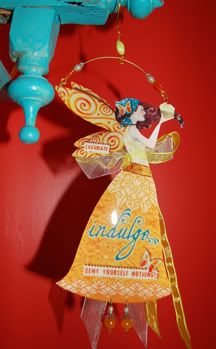
Another door guardian, from Art & Soul.


I [heart] this room.

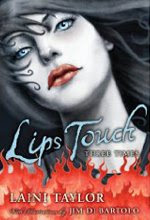
Below, hanging where I can see them, are two of the many pieces of art Jim did for Lips Touch that didn't make it into the book:

There was quite a process of deciding on just the right approach to the art for this book, and as a result, there are many incredible images that will never be seen. I'd still like to collect them in a little blurb book some day, perhaps along with the original (very short) versions of the Sunday Scribblings that later became the stories in the book. Plus, such an endeavor would feed my love of designing books, which I indulged for a solid week a year ago when putting together a Shutterfly book of our Chiapas trip.

Oh, look at this sunset from the other day:
Glorious!